Q & A with Tiffany McDaniel, author of The Summer That Melted Everything

Last week I hope I inspired you all to trot right out to your local indy bookstore, B&N, or log on to Amazon to purchase Tiffany McDaniel’s The Summer That Melted Everything.  Hopefully, you’ve all had copy in your hot little paws since then reading away.  If not, SHAME ON YOU!!  Get off your keister right this second, buy the book, then sit down with it, crack it open, and don’t do anything else until you’ve finished it!

Tiffany McDaniel  Photo Credit JENNIFER MCDANIEL 2016

This week, I was lucky enough and honored to have a little Q & A session with Tiffany to pick her brain about this book that I love so much:

1.  The Summer That Melted Everything is your debut novel.  Your writing is so lyrical, mature and confident.  How long have you been writing and what has the journey been like from beginning to published book?

First off, thank you for the kind compliments about my writing.  To answer your question, I’ve been writing since I was kid and was old enough to hold a crayon in my hand.  I didn’t know at that time when I was scribbling on the page that I was creating story.  I just knew I was putting down what was in my head.  I wouldn’t realize writing was a profession I could have until I was in middle school and the guidance counselor came to my class to talk to us about what we wanted to be when we got older.  Writing was just so wonderful to me I didn’t think you could get paid to do it.  My parents had jobs, very hard jobs that made them tired and not a lot of money.  So I thought that’s what I would have to do.  Have a job that I didn’t like and that didn’t make me happy.  Though it took me eleven long years to get a publishing contract, realizing I could have writing as a career was like being given wings and the sky to fly for eternity.  Though at that time I didn’t know how hard it is to become a published author.  To answer the second part of your question, the journey to publication for me has been long and difficult.  I wrote my first novel when I was eighteen.  I wouldn’t get a publishing contract until I was twenty-nine.  It was eleven years of rejection and fear I’d never be published.  Publishers don’t take a lot of risks on accepting literary fiction, especially darker literary fiction like what I write.  This struggle to get published is the narrative so many authors have.  The road to publication is discouraging and heart-breaking.  I feel for those still on the journey to publication.  To them I say, never give up.

2.  It’s now been a little over a week since the release of the novel.  What were your feelings leading up to the release, and what has life been like since The Summer That Melted Everything made its appearance in bookstores?

My feelings leading up to the release were a lot of nerves and fear.  It took me so long to get here.  Even with the book contract, I didn’t know that on average it takes two years to move a book through a traditional publishing house, so with all the years added up I’ve been waiting thirteen years to see a book on the shelf.  That’s a rather long time, so there’s that fear of what if The Summer that Melted Everything doesn’t do well enough that I get to have a second book.  As in the case of every author, sales determine an entire writing career.  Life since The Summer that Melted Everything made its appearance has continued to be a nervous time watching the book fall on the list, rise a little, and then fall back down.  Watching that can make an author go insane, so I’m trying not to focus too much on that and continue to do what I can as the author to get the book out there to readers.  Half the battle with a debut is just getting people aware the novel and the author even exists.  There are so many great books out there and so much competition, it’s hard to think the book will have any success and very easy to feel defeated by those thoughts.

3.  What was the genesis of The Summer That Melted Everything?  Was it a random thought or observation that inspired you, is the novel semi-autobiographical, or was it spurred on by something else entirely?

The Summer that Melted Everything started first as a title.  It was one of those Ohio summers that was so hot I just felt like I was melting.  All of me just dripping and dropping under the summer sun.  So that’s where it first started.  Just one hot summer.  I always start a new novel with two things.  The title and the first line.  These two things determine what the entire story is going to be about.  I never outline or plan the story beforehand.  It evolves with each new word and page.  There wasn’t a particular event or moment that made me write The Summer that Melted Everything.  It hard to say where the ideas come from exactly or what inspires them, just because creativity is hard to explain because even I don’t know where these ideas come from.  My answer to that is usually the ideas come from the elements that make me.  From some sort of chaotic spiraling shape twisting through the universe of my soul.  Rather dramatic of an answer, but I think the dramatics of creativity is what spurs us all on.

4.  Fielding Bliss narrates the story of the devil come to town in the form of a young black boy named Sal.  Fielding and Sal are the two main characters and driving forces of the novel.  Who are your favorite characters?  Who is your least favorite?

It’s hard to say my favorite character because I love them all.  One of my favorite characters to write was Sal.  He’s the one come to answer the invitation, so he presents himself as the devil.  This type of mysterious character is always interesting to write because it’s not often an author gets to write dialogue for the so-called fallen angel.  More than that, Sal is an old soul in a young body.  That sort of poetics and wisdom is always a joy to write.  My least favorite character is perhaps Ryker.  I won’t say why he’s my least favorite character because I don’t want to spoil the novel for anyone.  But once readers read the book, they’ll understand what I mean when I say Ryker is such a jerk.

5.  While I loved Fielding and Sal, I was most taken with Grand, Fielding’s brother.  I also thought Aunt Fedelia was a hoot!  Were there real-life inspirations for either of these characters or were they born straight from your imagination?

I love Grand.  He’s one of the characters that is so easy to fall in love with because he’s…well….Grand.  And Aunt Fedelia was really fun to write too, especially her foul language.  There weren’t real-life inspirations for either of them, or any of the characters for that matter.  For me, my characters have flesh and bone and are as real as any of us.  They are truly their own people.

6.  Besides the ever present heat imagery throughout, snakes also seem to be a recurring theme.  I happen to like snakes and have had a couple as pets in the past, so I loved the line, “You can tell a lot about a man by what he does with a snake.”  So true in many, many ways and symbolic of actions taken by man out of ignorance.  Any particular reason snakes play a role in your novel?

I like snakes too.  They catch me off-guard sometimes in the garden when a garden snake goes slithering by, but they don’t bother me and I don’t bother them.  I remember a neighbor talking once about how her and her husband will kill a snake if they see one.  Their hatred of snakes is due to the biblical story we all know so well of Adam and Eve.  A negative association has been bestowed upon snakes since that Garden of Eden moment and unfortunately snakes have been given a bad rap.  Because of their religious associations, snakes naturally found their way into the novel.  I hope their role in the novel reminds us all that we have to worry more about the man whose hands hold the snake, than we have to worry about the snake itself.

7.  Having lived through the ‘80s as a teenager and 20-something, I was astounded at how well you evoked the decade as the timeframe for the novel.  Bananarama, Aqua Net, Van Halen, the AIDS epidemic, Rambo, even a Delorean makes an appearance in small Ohio mountain town of Breathed.  What made you choose that decade?

When I was thinking of the time-frame in which to set the novel, the 1980s came to mind almost immediately.  When I think of the ‘80s, I think of neon colors, big hair, and sun-tans by the boom-box.  It almost seems like a decade-long summer, so of course I felt it was a natural fit for the summer in the novel.  I was born in 1985, so I don’t know how the 1980s really were, but for those of us who didn’t experience the decade we can get a sense of the atmosphere from shows filmed in that decade and the photographs taken.  Furthermore the year 1984 fit with George Orwell’s masterpiece, 1984, which is referenced in the novel.  I don’t want to give any spoilers away, but having his book and the year of the summer line up was important to the core of the story.

8.  If you could pick one thing, what do you wish readers would take away from The Summer That Melted Everything?

I suppose I hope readers take away the thing that most of us are taught from an early age, but that which we seem to forget as we get older, and that is to love each other a little more and remember that the only thing hate will get us, is a lot of regret.

9.  What’s next in store from you for future readers and those of us who have already become huge fans?

I have eight completed novels and am working on my ninth.  The novel I’m hoping to follow The Summer that Melted Everything up with is titled, When Lions Stood as Men.  It’s the story of a Jewish brother and sister who escape Nazi Germany, cross the Atlantic Ocean, and end up in my land of Ohio.  Struggling with the guilt of surviving the Holocaust, they create their own camp of judgment.  Being both the guards and the prisoners, they punish themselves not only for surviving, but for the sins they know they cannot help but commit.


There is no way to thank Tiffany McDaniel enough for giving me the opportunity to pose these questions to her, and more importantly, for writing a novel that has completely transformed my summer!  I hope you give it the chance to do the same for you.  The Summer That Melted Everything is, by the farthest of fars, the best book I’ve read in 2016, and, with a bit less than half of the year to go, I have very little doubt that it won’t end up being my favorite read of the year!
The Devil Went Down to Ohio: Tiffany McDaniel’s The Summer That Melted Everything

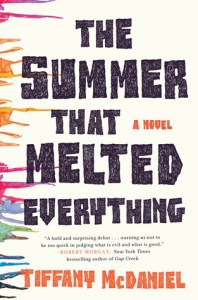
Sometimes a book affects you so deeply as to render you speechless, or nearly so.  Other times, a book will fill you with so many thoughts, ideas, questions and so much inspiration that you want to shout from the highest elevation, “Read this book or else!”  Sometimes a book accomplishes both feats simultaneously.  Such a wonder is Tiffany McDaniel’s The Summer That Melted Everything, due out from St. Martin’s Press on Tuesday, July 26.

The Summer That Melted Everything

“The heat came with the devil.  It was the summer of 1984, and while the devil had been invited, the heat was not.  It should’ve been expected, though.  Heat is, after all, the devil’s name, and when’s the last time you left home without yours?”  The devil’s name is also Sal, who arrives in Breathed, Ohio in the form of a young black boy who likes dogs and yearns for ice cream.

Sal comes to Breathed at the invitation of Autopsy Bliss (simply one of the most fabulous names in all of literature!), father of two and town prosecutor.  But Fielding Bliss, Autopsy’s youngest son, encounters Sal first and invites him home:  “If looks were to be believed, he still was just a boy.  Something of my age, though from his solemn quietude, I knew he was old in the soul.  A boy whose black crayon would be the shortest in his box.”  And so begins a summer of blistering heat, rising paranoia, and childhood innocence lost.

Tiffany McDaniel spins her tale from the point of view of Fielding, who speaks as both his teenage self and as the ruined 84-year-old man he eventually becomes.  As you begin to read The Summer That Melted Everything, you wonder how he ended up so hopeless and bitter.  By the end of the book you know.

Breathed is populated with myriad characters, all deep and fully-fleshed:  the aforementioned Autopsy; Dresden Delmar, an odd, introspective girl with a prosthetic leg; Fielding’s optimistic mom, Stella, with her global interior decorating skills and her phobic fear of rain and boiling things; rancorous, foul-mouthed Aunt Fedelia, whose method of staying cool in the heat is to lick her forearms; Elohim, a cruel midget whose paranoid leadership fosters hatred throughout the town; and finally, Grand Bliss – ah, lovely Grand with the perfect moniker – Fielding’s god-like, idolized older brother, who turns out to be just as human and tragic as any of us.

The Summer That Melted Everything is that rare book that I want to revisit yearly.  It’s so incredibly meaningful and lush that you could read it many times over and each time gain something new and glorious from it.  Passage after passage are both beautiful and painful at the same time.

Tiffany McDaniel’s book isn’t a joyful one and, in fact, can be downright depressing, reminding you of all of the evil in the world and the follies of misguided men.  But the language sings and soars, and you still feel better somehow for having read it.

How many sentences, paragraphs, entire pages did I want to quote for this review, to memorialize for my own remembrances?  Countless, but I only have so much space here and too many spoilers can ruin the wide-eyed experience of a new reader’s discovery.  How many times did I cry tears inside while reading Fielding’s and Sal’s story, yet in some way it’s not a complete downer.  I came away from the book wanting to be a better person and wanting to help others to be better people too.

I don’t know how to state it more clearly:  The Summer That Melted Everything is an astonishing accomplishment for any writer, much less a debut author like Tiffany McDaniel.  Equal parts Harper Lee and Shirley Jackson, with a dash of Ron Rash thrown in, McDaniel’s novel is destined to be a modern classic.  It should be required reading for all high schoolers and/or college students for the lessons it teaches of tolerance and intolerance, and vanished innocence (though it’s most definitely NOT young adult/new adult lit), and it should mop up come literary awards season.  If not, something is even more amiss with this already screwed-up world.

Full Disclosure: A review copy of this book was provided to me by St. Martin’s Press via NetGalley. I would like to thank the publisher and the author for providing me this opportunity. All opinions expressed herein are my own.

Be Careful Who You Follow Into Space!

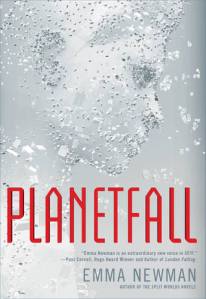
Planetfall

Emma Newman’s Planetfall appears, at first blush, to be a straight-up, sci-fi colonization tale.  A group of human space pioneers follows their leader, Suh, to an unnamed planet far, far from Earth.  Once the colonists arrive on said unknown planet, Suh vanishes into a huge, odd plantlike structure found growing, or possibly built, there and dubbed “God’s city” by the settlers.  Suh never reemerges from God’s city and becomes an oracle of sorts, believed to be still alive somewhere inside and called the Pathfinder by her disciples.  She even becomes the subject of an odd pilgrimage a chosen colonist makes into God’s city as a yearly rite.

Twenty years later, when the events of Planetfall take place, the colonists are thriving, having quite successfully built a life for themselves on this anonymous rock spinning through space.  You’ve got Mack, your strong, male colony leader with a secret.  Helping to keep that secret, and hiding secrets of her own, is your female protagonist, Ren, the colony’s master printer (practically everything the colony needs to exist, including food, is created by 3-D printers, a concept I have yet to entirely get my head around).  And you’ve got a wild card in Sung-Soo, a newcomer, offspring of two, long-thought dead, original colonists, and apparent grandson of Suh.

All’s good and usual in sci-fi land so far, right?  So while you, the unsuspecting reader, are trucking along, engrossed in this, your latest spacey discovery, you begin to realize that Ren, the first-person narrator of Planetfall, is just a weeeeee bit different from your average planetary colonist.  She’s fiercely private, she suffers from social anxiety and is a card-carrying introvert.  Shoot, I could even relate a little . . . to a point . . . until it became clear that there was something very, very off with Ren.  Hint:  There’s a reality show showcasing people like Ren.

And this is where Planetfall becomes a different kind of colonization tale.  I think it’s safe to say Emma Newman gets points for originality by incorporating a character with Ren’s particular disorder into her sci-fi work.  I can’t say I particularly liked Ren, even though I could empathize with her at first.  But her refusal to come to grips with her disease leaves me frustrated as she becomes increasingly more destructive to herself and the entire colony.

Newman has a new book coming out this fall, set in the same world as Planetfall.  I’m curious to see where she heads for the next installment.

Full Disclosure: A review copy of this book was provided to me by PENGUIN GROUP Berkley, NAL / Roc via Netgalley. I would like to thank the publisher for providing me this opportunity. All opinions expressed herein are my own.


A Trio of Twins (Sort of)

What are the odds that I would randomly read three books in a row that featured twins?  Two books maybe, but when twins showed up in the third book, even though they were minor characters, it started to get a little creepy.

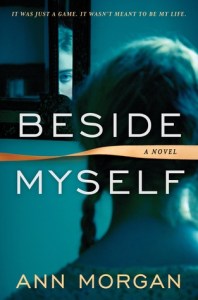
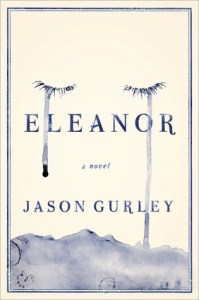
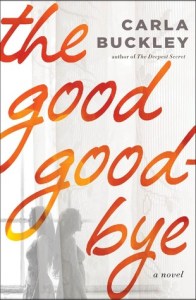
Beside Myself  Eleanor  The Good Goodbye

Ann Morgan’s Beside Myself, out from Bloomsbury back on January 12, is a disturbing, little thriller, one that would make any set of twins think twice about pulling the switcheroo trick on folks.  As a young girl in late ‘80s/early ‘90s England, Helen convinces her twin Ellie to swap places to see who they can fool.  An innocent game, right?  Not so much, and the consequences bring disastrous results for Helen for the rest of her life.  Much emotional trauma and mental illness ensue and it’s difficult to tell the villains from the victims.  I felt for Helen and her predicament at times; at others, when she managed to dig her hole even deeper, I just wanted to give her a good smack.  Sometimes, I wondered if the entire identity switch never even happened, instead possibly being contained entirely within the confines of Helen’s scrambled-egg brain.  At all times, I deeply loathed Helen and Ellie’s utterly rigid and dysfunctional mother, a beast of a woman whose main goal is to appear perfect at all times.

Ann Morgan is a decidedly British writer in style and tone which suited me just fine, and she has crafted a fantastic psychological debut novel in Beside Myself.  Take the time to check this one out.

January 12 also brought Crown’s release of Eleanor by Jason Gurley, which features another set of identical twin sisters, Eleanor and Esmerelda.  A car accident claims Esmerelda at the age of six or seven, leaving Eleanor and her parents adrift.  Her mother retreats inwardly into alcoholism, while her father abandons the family home, leaving Eleanor to grow up with her mother’s drunkenness and increasing rage.  As Eleanor enters her teen years, her reality begins to shift in the weirdest of fashions.  As she passes through a school doorway, she suddenly finds herself plunked smack in the middle of a beautiful cornfield.  She eventually manages to fall back into her own world only to find much more time has passed than she realized.  The next time her world shifts she’s thrown into a rainy, muddy wilderness.  These transferences, always against her will, increase and ultimately she learns much about her family’s loss and her shattered parents.

As I read Eleanor, smartly-written and compelling, I couldn’t decide whether Gurley was aiming his tale at adults or young adults.  These days I realize that just as many adults are fans of YA lit as teens are so I suppose it’s a moot point.  It could also be called a modern fantasy novel, given its dream-world dimensions, or even literary speculative fiction.  Whatever.  I should just shut up and say I found it lovely and ethereal and sad.  No matter what you call it, Jason Gurley’s Eleanor is a damn good book.

Twins also factor in The Good Goodbye (release date:  January 19) by Carla Buckley, although they’re the younger brothers of Arden, who is the main event here along with her cousin, Rory.  Arden and Rory might as well be sisters though, growing up tightly together with Rory as the ringleader and Arden as her loyal disciple.  Told from the differing perspectives of Arden, Rory and Arden’s mother, Natalie, Buckley’s novel explores family dynamic and dysfunction in the wake of a dorm room fire that leaves both girls clinging to life in a hospital ICU.  How did the fire start?  Who started it?  Were Arden and Rory two points of a love triangle that suddenly disintegrated?  What secrets were they keeping from their parents?  There was more than enough suspense and trepidation to keep me turning pages.

Several themes abound here:  the strength of familial bonds and how much it takes to break them, parental pressure, teenage secrecy and manipulation of parents and each other.  Rory and Arden are complex characters, each driven by different impulses to succeed in academics and life in general.  They have a fierce, sisterly love for each other, yet Rory is more than a little manipulative with Arden, and Arden almost always willingly caves.  It was hard to like Rory, but even harder to like her domineering mother, Gabrielle; as a result, while I found Rory’s ways more than a little objectionable, it was easy to understand the source of her psyche.

I was absolutely dying to find out the cause of and motivation for the fire, and I have to say, while some reviewers have indicated the ending was a let-down, I found it completely satisfying.  But no spoilers here.  You’ll have to read it yourself.

Full Disclosure: A review copy of Beside Myself was provided to me by Bloomsbury USA via NetGalley; a review copy of Eleanor was provided to me by Crown Publishing via NetGalley; and finally, a review copy of The Good Goodbye was provided to me by Random House Publishing Group – Ballantine via NetGalley. I would like to thank each of these publishers for providing me the opportunity to read and review these titles. All opinions expressed herein are my own.

Kevin Hazzard’s A Thousand Naked Strangers

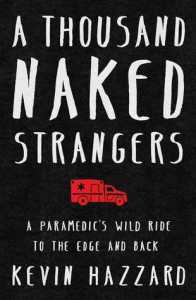
A Thousand Naked Strangers

“I did nothing to save the first person who died in front of me.”  An inauspicious beginning to Kevin Hazzard’s decade-long career as an EMT, then paramedic in Atlanta’s mean streets, to say the least.

In the aftermath of 9/11 and at the age of 25, Kevin Hazzard found himself searching for a way to make a difference with his life.  He abandoned his second of two back-to-back unfulfilling jobs and began training as an Emergency Medical Technician.  “Our class begins in March and wraps in December, putting the education of an EMT – one of two people sent to save your life should the worst happen – at eight months.”  A sobering thought.  But then I learn that the second of the life-saving pair is a paramedic who has more autonomy with immediate treatment decisions and has undergone “an additional eighteen months of training.”  A slightly less sobering thought.

Upon completion of his course- and fieldwork, Hazzard applied to Grady Hospital EMS, the crème-de-la-crème of metro-Atlanta medic postings.  According to Hazzard, Grady medics are “the standard by which all medics . . . are measured.”  He was rejected for lack of experience.  He then tried various fire departments and Rural/Metro Ambulance which covered areas of Fulton County not serviced by the Grady folks.  No luck.  He finally landed his first job with FirstMed Ambulance, a semi-shady outfit which provided private ambulances for transport of the old and infirm to doctor’s appointments and hospitals.

It turns out that Hazzard’s response to his first dying patient was perfectly understandable, in fact even appropriate in the face of the patient’s DNR – Do Not Resuscitate order.  When confronted with the elderly and/or terminally ill, first responders must determine if a DNR is in place, then treat (or not) accordingly.  “Ostensibly, we’re here for the patient, but really all we care about is the DNR.”  This thought stops me in my tracks.  Of course the EMTs and paramedics would need this all important bit of info, but “all we care about”?  Really?  Callousness, or coping mechanism?

From here the ride gets riotous and bumpy in the best of ways, as Hazzard climbs the EMS ladder to Rural/Metro and finally to the coveted Grady EMS.

Hazzard pulls no punches, and if you’ve got a queasy stomach or are the least bit prissy about blood and bodily functions, I’d suggest you stop right here.  His writing style is staccato-fast, raw and spontaneous, and he doesn’t hold back on the gore and gross-out factors.  He’s also terribly blunt:  “Disturbing as it may be, the . . . truth is that often enough the people showing up to your medical emergency do so because this was the only respectable job they could get with a GED and a clean driving record.”  I learned this disconcerting fact before the end of the second chapter.  Scatological humor (which I happen to dig – you may not) is also sprinkled liberally throughout; at one point he gives new meaning to the term “dirty bomb”.

Hazzard doesn’t avoid the fact that, in order to survive such an emotionally-charged career, many medics develop a seriously thick skin and morbid sense of humor.  Some get off on the rush, the high of returning a patient from the dead.  Still others are insolent and disrespectful, miserably inept or on the fast track to burn-out.  But most manage to serve with kindness and conscience.

Full Disclosure: A review copy of this book was provided to me by Scribner via Netgalley. I would like to thank the publisher for providing me this opportunity. All opinions expressed herein are my own.

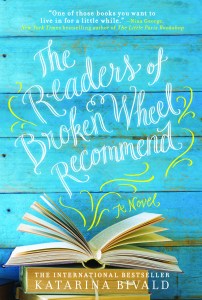
Katarina Bivald’s The Readers of Broken Wheel Recommend, and a Book Giveaway!

9781492623441-300

A book about reading . . . a book about a reading obsession . . . a book about a woman who would rather read than do just about anything else, who almost requires books just to survive?  Sounds like my kind of book.  In fact, it almost sounds like it might be about me (although my horses, my dogs, music and hiking give the books a run for their money on most days too).

Swedish author Katarina Bivald brings us The Readers of Broken Wheel Recommend, her first novel to be published in the United States, and it starts with promise.  Sara, a mousy former bookstore employee from Sweden, arrives in the tiny, hard-luck town of Broken Wheel, Iowa to meet and visit with her pen pal, Amy, an elderly resident of this little burg. Amy and Sara have bonded over books during their two-year correspondence, but Sara hits town only to learn that Amy’s funeral has just ended.   She wonders if she should just return home, having unknowingly walked into a disaster after all, but the occupants of Broken Wheel convince her to stay for a bit.  As Sara herself thinks, “As long as she had books and money, nothing could be a catastrophe.”  I agree with this philosophy wholeheartedly, if I do say so myself.

In an effort to ingratiate herself with the townspeople and to get these folks to read (it seems that none of them do), she decides to open a bookshop with Amy’s books as inventory.  Slowly, Sara develops friendships with several of Broken Wheel’s oddball citizens:  George, the reticent but well-meaning alcoholic; Jen, a busybody housewife and determined matchmaker; Grace, the opinionated proprietor of the local greasy spoon; Caroline, a younger, steelier version of the Church Lady; and Tom, the strong, silent-type subject of Jen’s matchmaking attempts.

We learn about the town and its denizens through Sara’s direct relationships with them, and through Amy’s letters to Sara, which function as flashbacks of a sort.  It’s in these letters that the book came alive for me, and I looked forward to the appearance of each one for Amy’s books recommendations.  Sara also pushes her favorites:  “She had sold countless copies of Terry Pratchett’s books before, only a few years ago, she had given in and read one of them, making the acquaintance of one of the most fantastic, and definitely most reliable, authors you could ever hope to find.”  She had me at Terry Pratchett.

And she continued to have me through the first two-thirds of the book or so.  But as more and more time passed in Broken Wheel, and as the situation in which Sara finds herself became a little less plausible, the hold the book had on me began to slip.  The literary references dwindled and the focus became the wacky marriage plot cooked up by Sara’s newfound friends so that she can outstay her tourist visa.  The subsequent, over-the-top events seemed a bit of a contrivance to me, although I suppose something similar could conceivably take place in small-town America.  At this point, I felt like the novel somewhat lost its way and couldn’t decide whether it wanted to be book lit, chick-lit, contemporary women’s lit, some kind of cozy, or a straight-up romance (and we all know I don’t do romance).

If you’re a fan of any of the aforementioned genres, then don’t let my disappointment with the latter part of the book keep you from checking it out.  It’s a light-hearted, whimsical read that I’m sure will appeal greatly to women of all stripes and book clubs across the country.  I enjoyed it enough to give it three stars on the Goodreads scale (3.5 on my own personal scale), meaning I liked it just fine but I didn’t absolutely love it.

If you would like a chance win a copy of The Readers of Broken Wheel Recommend from the publisher, check out this link to their giveaway:

a Rafflecopter giveaway

RBW-Blog-Tour-Graphic

Full Disclosure: A review copy of this book was provided to me by SOURCEBOOKS Landmark via NetGalley. I would like to thank the publisher for providing me this opportunity. All opinions expressed herein are my own.


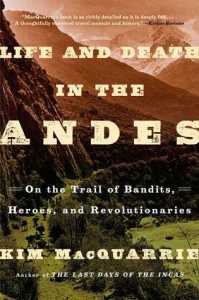
Kim MacQuarrie’s Life and Death in the Andes: On the Trail of Bandits, Heroes, and Revolutionaries

Life and Death in the Andes

After reading Kim MacQuarrie’s Life and Death in the Andes:  On the Trail of Bandits, Heroes, and Revolutionaries, I’m ready to pack my bags for South America.  Or at least Peru.  But not Colombia . . . definitely not Colombia.  From the Incas to Pablo Escobar, from Charles Darwin to the Shining Path, from Che Guevara to Butch Cassidy and the Sundance Kid, the western coast of South America plays host as MacQuarrie, a documentary filmmaker as well as writer, takes us on a thumping trip down the length of the Andes.

Little did MacQuarrie know, as a young kid growing up in Nevada, that the authors he read to escape the heat, namely and among others, Edgar Rice Burroughs and an adventurous dude named William Willis, would inform his later years and lead him to spend much time living in, exploring, writing about and filming South America and the Andes in particular.  It was Willis’ account of his successful jaunt across the Pacific on a balsa-wood raft that led MacQuarrie to volunteer in Peru for a subsequent, but unrelated, raft expedition.  He didn’t get the gig, but the failed application did lead to a chance encounter with an even-bigger transoceanic rafting celebrity, Thor Heyerdahl, who invited him along on an inland Peruvian excavation project.  Talk about your good timing!

The trip starts in Colombia and I quickly learn that it’s been a damned violent place, as if I didn’t already know that.  We’ve all heard, at least peripherally, about Pablo Escobar and the Medellin cartel, and MacQuarrie makes a great study of the drug kingpin’s rise to the lofty heights of the Forbes’ billionaire list (who knew Forbes was so undiscriminating?) and his inevitable plummet and death.  What I had lesser knowledge of was Colombia’s bloody history of political violence and civil war in the hundred or so years prior to Escobar.  It’s made clear though, that despite the fallout from political upheaval and drug wars, Colombia’s culture has also contributed greatly to international art and literature.  It’s a country that has given the world Medellin artist Fernando Botero, whose famous sculptures can only be described by me as bulbous.  Another Colombian native you may just have heard of in the realm of great contributions to literature:  the late Gabriel Garcia Marquez, whose novels are shot through with the brutal echoes of Colombia’s past.

Next up on the itinerary is Ecuador, or more specifically the Galapagos Islands.  It’s here that I learn that Darwin was actually a rank amateur in the scientific department when he arrived in the Galapagos aboard the HMS Beagle.  I had always dwelt under the assumption that Darwin was a seasoned naturalist and that the expedition was planned by and for him, but au contraire!  The Beagle’s mission was to finish surveying Patagonia and its captain was looking to hire an “educated companion” and naturalist, whose job would be to collect specimens but not analyze them.  That was to be left to the trained scientists back in Merry Old England.  Darwin, at 22 and newly graduated from Cambridge with an eye towards becoming a minister, seemed hardly qualified.  In fact, he was so inept at collecting that he failed to bring back even one adult tortoise from the expedition, although four juvenile specimens were returned to England.  And here’s your crazy factoid for the day:  Upon arriving in England, Darwin soon realized that the climate there was far from primo for his young tortoises so he prevailed upon a colleague who was retiring to Australia to take them there.  The last living one of the original four, a female named Harriet, died in 2006 at Steve Irwin’s Australia Zoo, a whopping 176 years after she sailed to England with Darwin.

Peru merits several chapters, presumably because MacQuarrie spent far more time in that locale than the other Andean countries, but also because it seems to have just so many damn interesting things going on there.  MacQuarrie chronicles the Shining Path guerrilla movement of the 1980s and early ‘90s (still mildly active today), hikes to Machu Picchu and gives us the dirty low-down on its smarmy “discoverer” Hiram Bingham, and waxes rhapsodic about the Ice Maiden, a 15th-century mummy of a young girl sacrificed as an offering to the Incan gods.  Juanita, as she was called after her discovery on Mount Amparo, was found wearing perfectly preserved garments made of the finest, most intricate weavings.  From here, MacQuarrie deftly segues into a lengthy discussion of the preservation of traditional weaving practices in Peru today.  As part of his trip to a cooperative market where the Peruvian weavers hawk their wares, he was treated to a typical native lunch:  guinea pigs “served on a plate roasted and splayed, with their arms and legs stretching out, looking like road kill.”  Thanks, Kim.  You just killed my appetite and tempted me to hit PETA up for a Save the Guinea Pigs campaign.

Travelling a little further south to Lake Titicaca (a name that always inspired the giggles in my 8-year-old self), straddling the border of Peru and Bolivia, MacQuarrie then introduces me, his by now fascinated reader, to Los Uros, floating islands made of reeds that house and sustain an entire population.  Everything there, the residences, the boats, the furniture, the food – you name it – is made entirely from the reeds, called totora, that grow naturally on Lake Titicaca.

And have I rambled on long enough?  I should at least give you something to anticipate and leave off telling you chapter and verse about everything this Andean chronicle has to offer.  I must be coming off like the movie trailer that shows all the best scenes and doesn’t leave you anything but filler.  Don’t fret.  There’s a heap of adventure left and you’ll keep moving south into Bolivia and Chile:  Che Guevara, the ruins of Tiahuanaco (Ancient Aliens and Giorgio Tsoukalos’ electrified hair are not in evidence, thank God!), Butch Cassidy and the Sundance Kid, and the Yamana Indians of Tierra del Fuego are waiting.  And Darwin makes a second but final appearance!

I guess it’s apparent by now that I was quite enamored with this book and, as such, I give it a healthy 4.5 stars out of 5.  My one quibble however is with the ending.  I’ll just say that MacQuarrie ends his journey very abruptly.  So abruptly, in fact, that I questioned whether my advance reading copy was missing its ending.  While I normally wouldn’t even comment on this as typos are common with ARCs and come with the territory, my particular electronic copy had an inordinate number of editing goofs which couldn’t help but make me wonder about that ending.  Life and Death in the Andes has since been released so I’m sorely tempted to buy a copy to satisfy my curiosity.

To me, reading is all about learning and adventure, whether you’re traveling in your armchair with words or making your reading-inspired dreams a reality, the latter being exactly what MacQuarrie has done.  The Willis books spurred the failed volunteer opportunity which led to his meeting with Heyerdahl.  The Heyerdahl dig, as well as six months spent living with the primitive Yora tribe in Peru’s Upper Amazon, gave MacQuarrie the idea to travel the length of the Andes, chronicling its troubled history and colorful personages along the way.

Full Disclosure: A review copy of this book was provided to me by Simon & Schuster via NetGalley.  All quotes herein are from the review copy and may appear differently in the final print version.  I would like to thank the publisher for providing me this opportunity. All opinions expressed herein are my own.

Break’s Over!

So due to Xmas insanity and other crap that had to be dealt with over the extended holiday season, I took a lengthy break from this, my brand-spanking-new blog.  Probably not the greatest strategy ever employed by a novice blogger who would actually like a few folks to find and read what she has to say, but as the cliché goes:  You do whatcha gotta do.

I’m up to my neck in pre-releases to be read and reviewed so time’s a wastin’!  I’ve got a few reviews of new-release sci-fi, women’s lit and non-fiction to post in the next couple of weeks, and I still owe another installment or two of the Baker’s Dozen.  I also plan a glowing review of a fantastic book recently published by a dear, dear friend (all bias aside, it really is a terrific read!).  Finally, I’ve recently started a new mini-project:  working my way through Dick Francis’ catalog.  Given my horsey predilections, it’s a crying shame that I haven’t read more Francis than I have.  Time to rectify that, I say.

It’s a new year and a fresh start.  Glad to be back out here in bloggerland!

A Baker’s Dozen (Plus One) of My All-Time Favorite Books: Part III

As I write this, I’m still riding the wave of elation and rapture that is the beautiful beat-down my Carolina Panthers gave to the Dallas Cowgirls on Thanksgiving.  Luuuuuuuuke!!!!!  Cam and the Dab!  11-0 baby!  And to think the Vegas odds makers initially had a 3-7 Dallas team as the favorite over my undefeated boys.  What in the fuck were they thinking?  I guess the Panthers still are, as they always have been, the Rodney Dangerfields of the NFL.  But that was one collarbone and a 33-14 game ago.  How ‘bout some respect now, suckas?!

But forgive me my gloating.  Let’s get back to business.  Part III of the Baker’s Dozen (Plus One) is fresh out of the oven.

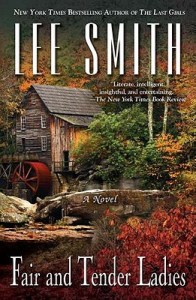
Fair and Tender Ladies – Lee Smith

I read across all genres, fiction and nonfiction, so long as it’s well written.  But Southern literature in all its variations is where my heart is, being a daughter of the South and all.  From Eudora Welty to George Singleton, from sweet, honeysuckle-scented stories to edgy Grit Lit, I love it all.

There are a multitude of contemporary authors you could start off with if your Southern lit education is lacking:  Reynolds Price, Kaye Gibbons, Jill McCorkle, Allan Gurganus, Ron Rash, Wiley Cash, Tim Gautreaux.  Or you can go old school:  the aforementioned Eudora Welty, Carson McCullers, Flannery O’Connor, Walker Percy, William Faulkner, Katherine Anne Porter.  The list is endless and stacked with literary behemoths.  I’d even go so far as to say that, in my opinion, no other region of the country is so steeped with written tradition and essence.

Fair and Tender Ladies

While there are any number of biscuit-and-gravy flavored books I could trot out here (it’d be easy to produce innumerable blogs posts about my Southern favorites alone), Lee Smith’s Fair and Tender Ladies has held a revered place in my heart for a long, long time.  One of my dirty little secrets is that I’m a sucker for epistolary novels, stemming from my reading at a very young age of Jean Webster’s Daddy-Long-Legs, and Fair and Tender Ladies is composed entirely of the correspondence of Ivy Rowe, a young girl growing up in the mists of Appalachia.  The epistolary tale is a rare bird these days, as is letter writing itself, an art lost to the millennial generation born of the instant gratification of texting.  If I shoved this book into the arms of an under-thirty-something, most of them would look at me as if I’d sprouted two heads.  So all you millennials out there:  download this one onto your Kindle or your iPad or your smartphone and find out what real correspondence looks like.

Ivy’s first letters bear the misspellings and colloquialisms of her age and her environment, but this book wouldn’t have worked nearly so well if Lee Smith had prettied up the grammar.  It’s Ivy’s unaffected, down-home voice that, as politely as possible, still smacks you upside the head and knocks you flat on your ass squarely in the middle of a holler in the Virginia mountains.  As Ivy grows up and becomes a mother, then a grandmother, her words gain maturity and polish but her voice never loses its direction.

I had the opportunity to meet Ms. Smith a year or so ago at a book signing for her then-new release Guests on Earth, but it was Fair and Tender Ladies that I wanted her to sign.

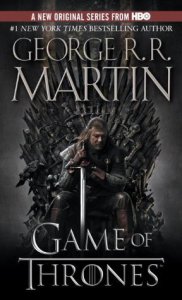
 A Game of Thrones – George R.R. Martin

Call me a sellout for placing A Game of Thrones on my all-time favorites list, since by now everybody and his brother has either read the books or seen the HBO series, but hear me out.

A Game of Thrones

I had never been much of a fantasy or sci-fi reader (other than Tolkien) and, like what I imagine are quite a lot of folks, I might have even considered myself above genre fiction of that sort.  I lumped it in with romance and took a literary snob’s view that most of its writers were hacks.  I have to admit I still feel that way about romance novels – I have yet to find a romance author who I think has any serious literary chops (yes, I hear the boos and hisses from the romance crowd – just don’t throw any tomatoes!).  Keep in mind it’s just my opinion so if I’ve now managed to alienate you romance aficionados out there, try to change my mind and let me know who you think is worthy.  I can be open-minded . . . I think.

So around early spring 2011, I hit a wall in my reading.  I was coming off a rough two or three years with my dad’s illness and then passing, and all of a sudden I found that I just didn’t want to read about real people with real problems (i.e., pretty much all fiction AND nonfiction).  I had had enough problems of my own to deal with for a while.  “Bon”, the attorney I work with who I’ve mentioned in a previous post, and a serious fantasy buff, suggested several of his sword and dragon favorites as potential escapes and alternatives.  I was skeptical but I figured, what the hey . . . so I picked up A Game of Thrones . . . and LIFE WAS NEVER THE SAME!

I landed smack dab in the middle of Westeros somewhere near The Wall and suddenly I knew I wasn’t in Kansas anymore, and no amount of heel-clicking was going to bring me back home any time soon.  That was fine with me; I didn’t want to be at home anyway.  I had developed some pretty asinine assumptions over the years about fantasy novels and their authors in general, but George Martin and his Starks and Lannisters put paid to that in short order.  These weren’t your cookie cutter wizards, fairies, knights saving damsels in distress.  These guys (and the girls too) were snarky, conniving, deadly, and charming as hell all at the same time.  Plus there were badass dragons.  Dragons are like horses, if horses could fly and barbecue your ass to cinders.  I fell in with Ned, Jon, Arya, Sansa (well, maybe not Sansa; she’s a little too sniveling for my taste), Tyrion, Jamie, Cersei, Daenerys, the Hound, et al. like I’d known them my whole life, then proceeded to be absolutely astounded at the rate in which George Martin slashed and burned his main characters.  Oh, and did I mention the man can write?

In all fairness, I should probably have just listed the entire A Song of Ice and Fire series as my entry here.  I read all five of the existing books in the series straight through, something I NEVER EVER do with series fiction.  Placing them here on a list of what is supposed to be my great literature recommendations may still seem like a cop-out to some of you higher-minded readers.  But what makes these books so special to me is that they accomplished two important things:  they provided me a welcome and ready safe haven when real life was taking a toll, and they offered a jumping-off point into a genre at which I’d previously sneered and of which I’m now a giant fan.  I’ve since read Nalo Hopkinson, Kevin Hearne, John Scalzi, Patrick Rothfuss, Robin Hobb, Ursula K. Le Guin, Philip K. Dick, Neil Gaiman, Lois McMaster Bujold, Glen Cook, China Mieville, Anne McCaffrey, Jack Vance and Arthur C. Clarke, and the list goes on.

Do yourself a favor and try reading something outside of your comfort zone.  It doesn’t have to be fantasy or sci-fi.  For you it might be horror or biography, mystery or history.  You might surprise yourself (like I did) and open up whole new worlds of exploration, enjoyment and knowledge.  And isn’t that what reading’s all about?

Oscar Hijuelos’ Twain & Stanley Enter Paradise

Twain & Stanley Enter Paradise

I receive advance reading copies (ARCs) from publishers for review purposes from time to time and I always make it a practice to read them in order of publication date.  I do this so my reviews will be as timely as possible and roughly coincide with each book’s release.  So when I finished The Early Stories of Truman Capote (November 23, 2015), I flipped to the next ARC on the list and came up with Oscar Hijuelos’ Twain & Stanley Enter Paradise.  Okay . . . so . . . the book I read immediately preceding the Capote collection was Lynn Cullen’s Twain’s End.  Were the book gods really going to make me read two Twain-based novels nearly right in a row?   Apparently so.  If I weren’t so damned OCD about my hard and fast publication date rule, I would have just put the Hijuelos aside for a month or so and come back to it later, but I’m a little anal about these things so I hunkered down and prepared to dive back into the world of Samuel Clemens.

If you read my November 11, 2015 post on Lynn Cullen’s book, you know that her Twain was a rancorous dude not much interested in giving a rodent’s posterior about anyone but himself.  So I wondered what kind of light Oscar Hijuelos was going to shine on the old coot.  A radically different one as it turns out.

Twain & Stanley Enter Paradise orbits around the actual, lifelong friendship of Mark Twain and Sir Henry Morton Stanley, controversial African explorer and supposed utterer of the legendary “Dr. Livingstone, I presume” line.  Twain comes off more like the revered figure most of us imagine, a better family man and friend than the one Lynn Cullen would have us know.  He’s a relatively considerate pal, a devoted husband and father, and just an all-around much nicer bloke to hang out with.  However, Stanley, not Twain, is the real star of the show here, as his voice is the principal one Hijuelos uses to narrate his sprawling tale.  The novel spans at least 50 or so years and we’re with Stanley every step of the way in his life, beginning with his arrival in New Orleans as a penniless orphan from Wales, to his first meeting with Twain on a Mississippi River steamer (Twain then being known only as Samuel Clemens and prior to his immense literary fame), to the sweltering jungles of both Cuba and Africa and finally to pastoral England.  We even backtrack a little to Stanley’s childhood before his abandonment by his mother and his eventual orphandom (okay, so the jury’s still out on whether “orphandom” is actually a word).

Hijuelos employs several narrative devices to relay the intertwining stories of Twain and Stanley.  At times he writes in the third person, giving the novel the feel of a Stanley biography instead of a fictional interpretation, and I frankly had to remind myself on a multitude of occasions that this wasn’t a biography.  Other times the epistolary voice takes over in the form of letters between Stanley and Twain and correspondence exchanged between Twain and Dorothy Tennant, Stanley’s portraitist wife.  Yet other chapters are set forth in the first person as either Stanley’s or Dorothy’s journal entries.  This constant tone shifting has the whole thing coming off as slightly schizophrenic, and truly the thing works best when it’s simply Stanley doing the talking from the pages of his diary.

For those expecting Hijuelos’ usual exuberant, Cuban-American themed fare, Twain & Stanley is a divergence, although the two men do venture together into Cuba searching for Stanley’s potential adoptive father (NOTE:  The Cuba jaunt is completely fictional, not based on any actual trip taken by the pair, although much of the book is rooted in the facts of their relationship as best could be gleaned from Hijuelos’ extensive research).  In all fairness, the author died unexpectedly before he ever submitted Twain & Stanley for publication so one can only presume that he didn’t get the chance to further shape, polish and winnow down his manuscript prior to his death.  According to his wife’s afterword, Hijuelos had been fascinated by Henry Morton Stanley since his teenage years, and the research and travel that form the underpinnings of this book were a labor of love that spanned more than twelve years.  You have to wonder though, had Hijuelos lived, would he be completely satisfied with the rambling Twain & Stanley we’re left with or would he still have some tweaking to do?

Full Disclosure: A review copy of this book was provided to me by Grand Central Publishing via NetGalley.  I would like to thank the publisher for providing me this opportunity. All opinions expressed herein are my own.