Growing up in the ‘70s, I always thought Truman Capote was an actor. You see, I had only seen him on the multitude of talk shows (Mike Douglas, Merv Griffin, Dinah Shore, etc.) watched by my parents and grandparents, and as Lionel Twain in the movie Murder by Death. It wasn’t until a good deal later, probably in junior high or even high school, that I realized he was far more well known as an author, and a damned good one at that evidently.
But even having been clued in to his status as a fine, fine writer for some time now, of all of his works I still have only managed to read In Cold Blood to date. I realize I have a lot of catching up to do.
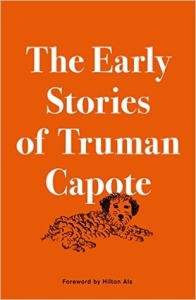
The stories collected in The Early Stories of Truman Capote are thought to have been written by Capote between the ages of 11 and 19 and, in truth, seven of the stories were actually published in his high school newspaper. According to the book’s afterword, “Louise”, one of the seven, was awarded second place in his school’s writing contest. Second? You have to wonder how the winner felt years later when Capote became a literary force. Did she (if it was a she) giggle to herself that her writing was once judged better than Truman Capote’s, or did he (if it was a he) want to crawl under a rock?
Most of these stories take place in the South of his early childhood and you can practically feel the sticky summer heat and humidity rising sinuously off the pages. In “Mill Store”, a jaded store clerk watches picnickers fish, swim and chow down on the banks of the creek behind her workplace, remembering a moment when she had fished the stream herself and caught “two moccasins. How she had screamed when she pulled the snakes up, twisting, flashing their slimy bodies in the sun, their poisonous, cotton mouths sunk into her hook.” First of all, I screamed myself when I read this and the visual still gives me the shiverin’ heebie-jeebies. Secondly, that memory becomes even more prescient when the clerk is called upon to save a young victim of snakebite.
A stubborn boy fails to heed the advice of his cagier friend and pays a deadly price for his actions in “Swamp Terror”, while the swamp is also the downfall of a desperate woman newly escaped from jail in “The Moth in the Flame”. Two high school girls each possess their own dark secrets in “Hilda” and “Louise” and add to the sense of desolation that washes over many of these stories.
But all isn’t complete doom and gloom in these worlds the youthful Capote asks us to inhabit. While still a tearjerker, “This Is for Jamie” is my favorite of the bunch in which a selfless eight-year-old generously brings gifts for a sick boy he’s never met and reaps the reward, proving that good things do happen to good people. Or maybe I just like this one because there’s a dog. I’m a sucker for dogs. Dogs make everything better.
If you’re like me and a relative Capote rookie, I probably wouldn’t recommend The Early Stories of Truman Capote as a place to start your Tru education. It’s not that I didn’t enjoy the collection. I actually did. But I don’t think it provides a newbie with anything remotely approaching a good overview of what he later produced. As a rule, these stories lack polish (not unexpectedly) and some end so abruptly you feel like you’ve been left dangling precariously over a gaping hole. But despite all that there’s no doubt that, even at such a young age, Capote was going to be a master at setting a stage, creating a world in which to plunk his characters down so they could take root and blossom.
Full Disclosure: A review copy of this book was provided to me by Random House Publishing Group – Random House via NetGalley. I would like to thank the publisher for providing me this opportunity. All opinions expressed herein are my own.
Only two titles on the list today. I was going to add a Lee Smith novel here as well but I ranted on so long about Ayn Rand’s Atlas Shrugged (which is kinda funny given the reason I give below for not finishing it) and The Fountainhead that I think I’ll give Ms. Smith’s lovely little book its due in the next installment. With that said, you’ll find two more of the BESTEST BOOKS EV-AH below.
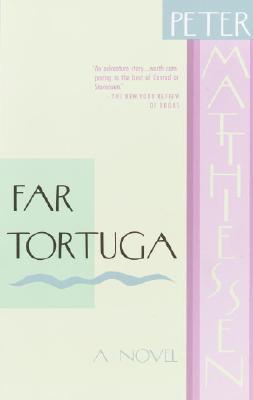
Far Tortuga – Peter Matthiessen
If you’re familiar with Peter Matthiessen’s work, Far Tortuga may seem an odd choice for this, a list of books I’d want with me on a desert island. He’s far better known for novels such as At Play in the Fields of the Lord and the Shadow Country trilogy, as well as nonfiction like In the Spirit of Crazy Horse.Far Tortuga is, or was at the time, worlds apart from anything else he’d produced, a novel written almost in verse and definitely in a non-traditional format. The sea and its Caribbean environs are characters just as important as the crew of the ill-fated turtle hunting boat, the Lillias Eden, whose last voyage is the subject of the book. I came to Far Tortuga already a Matthiessen devotee, having discovered him along with Edward Abbey (see my Baker’s Dozen, Part I post, October 19, 2015) in my mid-twenties, and I had already read In the Spirit of Crazy Horse, The Cloud Forest, and African Silences (all nonfiction) when I picked this up for the first time. The words on the page look and read like a prose poem, not the pedestrian paragraphs of your Average Joe of a novel, so I, not being the biggest poetry fan in the world, gave this book the big ol’ side-eye when I turned to the first page. But I found myself drawn into the Calypso-like rhythm of the sailors’ voices (“…Speedy-Boy, you best cotch turtles one time in dis life just so you know it”) and what I thought was going to be a chore to read flows like the clear, blue Caribbean itself.
Matthiessen, along with that cantankerous Abbey, was somewhat of a hero of mine back in the day. In addition to being an award-winning writer (he won the National Book Award three times), he was a naturalist, environmental activist, co-founder of The Paris Review, and, believe it or not, for a period of time a CIA agent! Matthiessen and Abbey went to town on my brain in the early ‘90s as I gobbled up book after book written by the both of them, and together they imbedded into my grey matter a still-unwavering love of nature and wilderness. I was never the same after encountering those two. Sadly, Peter Matthiessen died last year at age 86 after a battle with cancer. We still have his words.
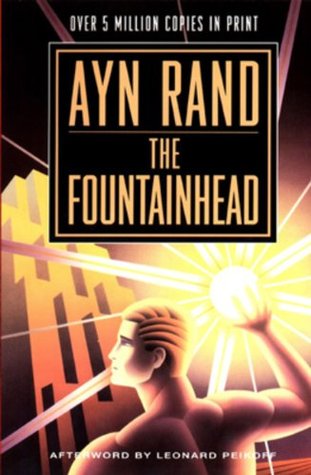
The Fountainhead – Ayn Rand
And I bet you thought Atlas Shrugged was going to be my Ayn Rand choice. Not hardly. I have yet to finish that effin’ doorstop of a book. It’s not that I don’t get that Atlas is supposed to be one of the greatest books ever written, and it’s not that I didn’t even like it somewhat, finding it, as I did, actually pretty relevant to some of the economic issues America is experiencing today. It’s that, in Atlas, Rand becomes the absolute queen of belaboring the point. Why be concise and clearly express an idea once when you can pound it into someone’s friggin’ head fifty different ways? There’s a Dilbert comic strip that expresses my sentiments about Atlas Shrugged perfectly (I can’t reproduce it in its entirety here, but I will quote it, with many thanks to Scott Adams). Imagine I’m Alice and Ayn Rand is Topper (at least I think it’s Topper in this particular strip):
Frame 1: Alice: “Excuse me, by my count, you’ve said the same thing 27 times, using different words.”
Frame 2: Alice: “If I can get sworn statements from everyone here that we understand your point, will you stop talking?”
Frame 3: Topper: “That’s mighty rude of you.”
Frame 3: Alice: “I don’t get your point. Can you repeat it 26 more times?”
But, unlike Alice, I do get Rand’s point. She told me once and I got it the first time. Didn’t need to hear it again. I finally gave up about two-thirds of the way through. I’ll give it another shot sometime in the future. After all, my relatively non-bookish Hubs finished it and liked it, and I can’t let him show me up.
But, oh yeah, I was supposed to tell you why I like The Fountainhead, which is, in my opinion, the best Ayn Rand book and one of my favorite books of ALL TIME. It was given to me, again in my mid-twenties, by an attorney I worked for at the time who was also a good friend. I don’t know why he thought I’d like it and I was a little perplexed when he gave it to me, but his gift was spot on. Rand’s story is of an unconventional, Frank Lloyd Wright-ish, up-and-coming young architect, Howard Roark. Roark is highly innovative, absolutely refusing to give in to convention with his designs, and this is the account of his fight against rivals who are threatened by his genius and will try destroy his reputation at all costs. His unwillingness to cave in the face of the interminable obstacles that he faces in his rise to the top of his profession is pretty damned admirable. Believe me, his enemies throw everything AND the kitchen sink at him trying to bring him down.
You know, I really can’t pinpoint exactly why I like this book so much. It’s about architecture, which doesn’t exactly blow my skirt up. I know an ugly building when I see one, but other than that, my knowledge and interest in the subject goes about as far as Frank Lloyd Wright. And who doesn’t know Frank Lloyd Wright?
It’s a book I don’t think I would have picked up on my own at the time (or maybe even now), but since it was given to me I felt obligated to read it and then, all of a sudden, I couldn’t get my sniffly, allergy-ridden nose out of it. It is very dramatic, with lots of tension and teeth-gnashing, and I think it just comes down to the fact that Ayn Rand wrote an epic potboiler of a novel. In any event, along with Far Tortuga, it’s time for a re-read.
Part III of the Dozen is in the offing, and I suspect it will have strong whiff of Southern Lit to it (smells like magnolias, ya’ll) as well as a little dab of fantasy. Adios, peeps!
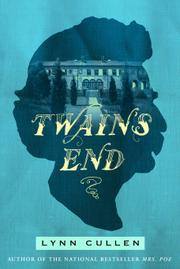
Who knew Mark Twain was such an ass? According to Lynn Cullen’s Twain’s End he was a nasty, bitter old man, and now my perfect little Twain bubble has been burst. I love Mark Twain – Huck Finn, Tom Sawyer, The Innocents Abroad, Life on the Mississippi – all classics that I’ve read, and sometimes re-read. No one disputes his status as one of this country’s literary greats. He was even pretty hot as a younger man (think Tom Selleck in his Magnum, P.I. days). Not that I’ve got a thing for dead guys, but still. Mark Twain has always been on a pedestal, unassailable in my mind, and now I might have to rethink this relationship! But seriously, I do get it that just because the man was an American icon doesn’t mean he was a good person to boot.
Twain’s End chronicles the relationship between Mark Twain and his personal secretary of many years, Isabel Lyon, and while reading, I had to constantly remind myself that this was a fictionalized account, not necessarily a true telling. Although written in the third person, the story is told mainly from Lyon’s point of view and Cullen is definitely sympathetic to her. I’m not sure I was though, but neither was I rooting for Twain. The relationship between Samuel Clemens and Isabel Lyon was almost certainly more than that of employer/employee, with the two becoming especially close after the death of Clemens’s wife. Lyon occupied a bedroom adjacent to Clemens’s in his home in Redding, Connecticut even though he had provided her with a residence (oddly referred to as The Lobster Pot) located on his property, and she referred to him incessantly as “the King” or “my King” (with a capital K no less – creeeeepppppyyyyy!) WTF? I detect an unhealthy case of hero worship (to put it mildly) here.
Clemens is drawn as a deeply troubled, boorish, egotistical man without much concern or care for the feelings of others, including his own family. He spends most of his time parading around as Mark Twain (partly to satisfy his fawning public and partly, I suspect, to feed his own massive ego), the bigger-than-life caricature that his fans, and a surprising number of his “friends”, expected to encounter. Unfortunately, Mark Twain tended to steal the show from Sam Clemens, and as a result, his family and others suffered for it.
Twain sacked Lyon not long after her marriage to Ralph Ashcroft, Twain’s business manager (he fired Ashcroft as well). Although the marriage was initially blessed by Twain, he ultimately accused Isabel of trying to steal from him and of being a “filthy-minded and salacious slut.” To back his play and to keep her from speaking out against him, Twain penned a 400-plus page diatribe outlining all of her supposed transgressions. Tell us what you really think, Mark (or Sam, or whatever you think we should call you).
All of this ugliness really occurred and it’s no spoiler to clue you in on these facts here: Lynn Cullen reveals the dust-up at the beginning of her book. Cullen did her research and most of the book is built around and recalls actual events (trips, meetings with celebrities, etc.) that happened among Clemens, Lyon, his wife, his daughters (Clara Clemens in particular, and also seemingly not a very nice person), and others. Cullen admits she relied heavily on Isabel Lyon’s own diary for her facts so you can’t help but wonder if this might have slung the book too far in Lyon’s favor. That said, and even though I have yet to read Twain’s own autobiography (Volume One of which was published for the first time in 2010, 100 years after Twain’s death per his wishes), I understand from various reviews that the autobiography tends to back up the fictional account portrayed here.
I enjoyed this book for the most part, being a fan of historical fiction and all, but I have to emphasize again that it reads like a non-fiction report of Twain’s later years, or like Lyon’s memoir (albeit in the third-person) had she actually written it. You may find yourself taking it as the gospel.
Full Disclosure: A review copy of this book was provided to me by Gallery Books via NetGalley. I would like to thank the publisher for providing me this opportunity. All opinions expressed herein are my own.
Over a year ago, I made plans with a close friend to attend the 2015 Breeders’ Cup World Championships at Keeneland, one of America’s most storied and sublimely beautiful horse racing venues. Little did I know then that I would be witnessing history on a steel-grey, autumn day in October.
Thirteen times since Affirmed won the Kentucky Derby, the Preakness Stakes and the Belmont Stakes in 1978 had a horse taken us into the final leg of the Triple Crown with the hopes of a nation astride him, only to be beaten in that grueling mile-and-a-half test of endurance that is Belmont. Many folks (most notably, California Chrome owner Steve Coburn in his 2014 post-Belmont rant) thought there would never be another Triple Crown winner, at least not in their lifetimes. However, between that day in March when I purchased our Breeders’ Cup tickets and a week ago Saturday when I stepped onto the Keeneland grounds, something happened that the horse racing industry, and the entire country for that matter, had been anticipating for 37 long, seemingly hopeless years: American Pharoah, an unassuming-looking, bay 3-year-old colt won the Triple Crown.
(Yeah, I took this photo! Me! Ears up!)
Unassuming, that is, until you saw him run. Never have I seen a horse run so smoothly, so effortlessly, making it look fun and running with his ears up, a sign all horse people know means that horse is enjoying the hell out of himself! Pharoah makes the others look like they have to fight for every step while he’s out front on the lead, good-bye, sayonara, catch ya later! He won on every surface, in every condition, at every length from 7 furlongs to a mile and a half. In what I think might be the coolest looking race he won (although definitely not against the strongest field he ever faced), he bested the rest of the bunch in the 1 1/16 mile Rebel Stakes at Oaklawn Park, leading it wire to wire again with his ears up almost the entire way, leaving the other contenders in the final furlong to trounce them by 6 ¼ lengths in the slop! And jockey Victor Espinoza never even went to the whip!
Only twice going into the October 31 Breeders’ Cup Classic was Pharoah ever beaten: Once in his first race as a 2-year-old and then again on August 29 in the Travers at Saratoga, a race that came after a 3-year-old season having, up to that point, consisted of two Derby prep races, the punishing Triple Crown campaign and the Haskell Invitational a few weeks earlier in August. Is it any wonder the horse was pooped going into the Travers, especially when you also take into account the cross-country shipping he endured almost every time he raced? And he still ran a gallant second even then.
A horse like Pharoah runs like he does because he’s bred to do it and he’s bred to love it, and love it he does. Watch his body language: Does this horse look like he’s being forced to do something he doesn’t care for? Horses, all of them, not just Pharoah, are bigger and stronger than us. They don’t have to do what we ask of them. If they only knew, they could take charge and tell us humans to take a hike. Yet they don’t (or at least most of them don’t). They readily submit to what we ask of them, and a true horseman, one who respects his or her four-legged partner, doesn’t ask more than the horse can give. Both horse and rider feed off of the bond of trust that’s established between the two. It’s hard, maybe even impossible, for a non-horseperson to understand. But because I do understand it, and experience it on a regular basis with my two American Saddlebreds, it makes what American Pharaoh has accomplished even more incredible to me than the average layperson may ever be able to comprehend.
So after Pharoah’s history-making win in the Belmont Stakes, it hit me that possibly, quite possibly, if the stars aligned just right and Pharoah stayed healthy and sound, I was actually going to witness a Triple Crown winner in the flesh come Breeders’ Cup time in October. But he’s just a horse one might say. A word of advice: Don’t ever say those words to a horse owner. A horse is never just a horse, and this horse in particular is beyond special.
We got up before daybreak on Thursday, October 29, in hopes of seeing Pharoah work on the Keeneland main track. I had a blistering migraine but that didn’t matter. I was going to see Pharoah close-up if it killed me. It had rained the day before and Pharoah’s trainer, Bob Baffert, had then decided to hand-walk him under tack in the shed row instead of taking him to the track, so the anticipation was high that he would make an appearance Thursday morning. Although the rain had moved on, the main track was still sloppy when we arrived at 6:15 a.m. along with several hundred other folks who also wanted to catch a glimpse. We waited about two and a half hours with no Pharoah, although we got to see plenty of other Breeders’ Cup contenders exercise.
About thirty minutes before the track was scheduled to close for the morning, the PA announcer oh-so-politely let us know that Pharoah’s connections had determined the main track was still too sloppy. It had been decided that the mighty Pharoah was going to work on Keeneland’s synthetic training track instead. At that, we all bolted the quarter-mile down the hill to wrestle for a good spot on the training track rail. You ever tried to run that far with a migraine? It ain’t easy, peeps, but I did it.
We waited about another 10 minutes and then here he came, down the hill at the far end of the track, in the company of his sidekick and stable pony, Smokey. They traveled clockwise about halfway down the backstretch and disappeared behind some trees. And then . . .a bay streak came flying from behind the tree cover and he was on his way towards us . . . fast! Finally, I was watching Pharoah run with my own eyes and it was beautiful.
He made three circuits of the training track and then his exercise rider pulled him up just to our right. He turned and trotted by us one last time about 20 feet away . . . and then he was gone. It was enough.
(Yeah, I took this one too!)
I love horse racing, but it does have a dark side, one that I sometimes struggle with, being a fan of the sport but also being an animal lover. That’s another topic for another blog post however, and on this weekend, I just hoped to be lucky enough to witness history. Importantly though, as far as the Breeders’ Cup Classic was concerned, yes, I wanted to see Pharoah race and yes, I wanted him to win, but more than anything I just wanted Pharoah and all of the other horses running to come out of the race safe and sound. I got my wish.
Having attended the Breeders’ Cup in 2010 when Zenyatta ran (and sadly, lost) her last race, I knew there would be no getting near the paddock to see American Pharoah during saddling for the Classic, so we contented ourselves with waiting for his appearance on the track in the post parade. Nervous is an understatement as to how I felt when he emerged from the tunnel, and I said a little prayer for everyone’s safety. Post parade completed, they loaded the contenders into the gate and they were off! Victor Espinoza sent Pharoah straight to the front and when they came by us the first time, he had his ears up yet again. Our seats were such that we could see the entire track, backstretch and all, and for most of the race, his ears never wavered. Pharoah opened up a little lead on the other horses and everyone settled in. As they neared the end of the backstretch, the field started to come to Pharoah a little bit and I began to get worried. Silly me, I forgot Pharoah’s and Espinoza’s M.O.: Espinoza hadn’t even asked his horse for anything yet. As they came around the final turn, he did . . . and Pharoah opened up!
Just like that American Pharoah and Victor Espinoza came down the homestretch for the final time, this time right in front of me, widening the gap and winning the Breeders’ Cup Classic by a dominating 6 ½ lengths. Needless to say, no other horse was even closing at the finish. I know it’s cliché, but I did have chills, chills on top of chills. I cried, we screamed, we hugged strangers, strangers hugged us back. And on that day, the last Saturday in October 2015, I, and 50,000 of my closest friends, witnessed a horse do something no other horse has ever done in the history of this great world, something that had to be given a new name: American Pharoah had won the Grand Slam of horse racing. It was enough.
(POSTSCRIPT: In a bit of coincidence, or serendipity, or whatever you want to call it, American Pharoah now resides at Ashford Stud in Versailles, Ky. in a stall formerly occupied by a now-deceased stallion who previously stood there. The stallion’s name: Grand Slam.)
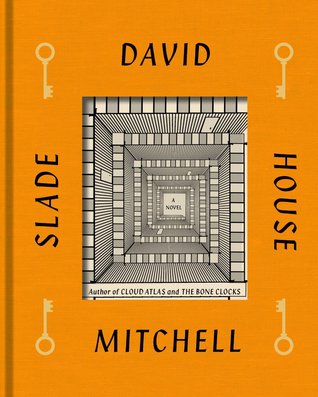
My experience with David Mitchell to date is limited to The Thousand Autumns of Jacob de Zoet which I read earlier this year. It’s shameful but I have yet to read Cloud Atlas, even though it’s sitting in my TBR pile along with Black Swan Green and number9dream.
Thousand Autumns was a dense, atmospheric historical that, while I thoroughly enjoyed it, I would not categorize as “light” reading. Slade House couldn’t be more different. It skips along at a goodly clip and you could easily read it in one sitting.
So this is what Mitchell’s twist on the haunted house tale looks like: Every nine years, a small door appears in Slade Alley (itself located in a small English town), beckoning certain people to explore what lies on the other side. What these people find is initially enticing, offering up to each person something missing but badly desired: For the first victim, Nathan, a high-functioning, autistic boy, who enters Slade House along with his mother, it’s the promise of a friend who finally gets his quirks and differentness; for the divorced police detective who stumbles upon the alley door nine years later while investigating the disappearance of Nathan and his mother, it’s the promise of a roll in the hay with the young widow who seemingly inhabits Slade House; another nine years along, six, paranormal-obsessed college students, having heard the rumors about Slade Alley and its mysterious disappearances, want nothing more than to see a ghost or two. Unfortunately for all these poor folks, once you enter Slade House you’re doomed to die there. I was going to insert a “Hotel California” reference here but David Mitchell himself beat me to it, dang it!
I read innocently along, lapping up the spookiness through the first three segments of the book, then happened to stop and read a couple of reviews by some folks that, like me, had received ARCs of the book in advance of its publication. Oops. Turns out I picked up David Mitchell’s Slade House not realizing that it’s a sort of companion piece to The Bone Clocks, a book I have yet to read. As I kept reading with this new knowledge, it became apparent that, while the book functions just fine as a stand-alone, I probably would have gotten even more meaning out of it had I read The Bone Clocks first. So . . . now I’ve ordered The Bone Clocks from Amazon so I can throw it in the TBR pile with the other Mitchell books. Sneaky, David Mitchell, luring me in with what I thought was a one-off, only to find that you really wanted me to read The Bone Clocks all along! I did catch the blink-and-you-miss-it connection to Thousand Autumns though, and 1,000 points to anyone else who spies it.
NOTE: Slade House is expected to be released on October 27, 2015.
Full Disclosure: A review copy of this book was provided to me by Random House Publishing Group – Random House via NetGalley. I would like to thank the publisher for providing me this opportunity. All opinions expressed from here forward are my own.
Time to trot out a list of some of my very, very favorite books ever, those closest to my heart, the ones that knocked my world ever so slightly off its axis. You may like them, you may not, but you should at least give them a try. Some are obvious choices, some are hiding just beyond that tree over there, but each one of these, at the time I read them, stirred up something deep inside me that I couldn’t always quite name. Stand aside and welcome the first three on the list (in no particular order):
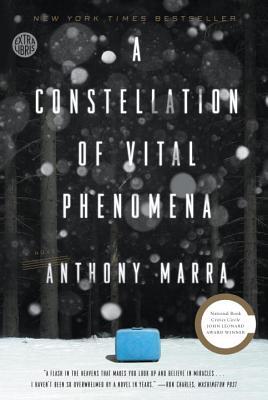
A Constellation of Vital Phenomena
This is a VERY fresh addition to my list, but a most deserving one. You might think that a novel taking place in the recent history of war-torn Chechnya couldn’t be anything but a complete downer, but you’d be wrong. Set in depressing circumstances, yes, but Anthony Marra’s 2013 debut novel punched me flat with the darkly funny, warped humor of its characters. This particular exchange caused me to choke on my wine:
“’Let me tell you a story,’ the brother said, holding his cigarette like a conductor’s baton. ‘When I was a child I had a pet turtle, whom I named after Alu because they shared a certain – how can I put it – bestial idiocy. Once I went to Grozny with my father and five of my brothers for the funeral of my father’s uncle, and we left so quickly I hadn’t the time to provide the food for Alu the Turtle. My brother, Alu the Idiot, had a fever and stayed home with my mother. In a moment so taxing on that little intellect that steam surely shot from his ears, Alu the Idiot remembered to feed my turtle. He caught grubs and crickets, likely tasting them before he gave them to my beloved crustacean. Since then Alu the Idiot has grown into a Gibraltar-sized hemorrhoid, but when he was a child he used the one good idea his life has allotted him to feed my turtle, and because of it, you get a second favor.’
‘Turtles aren’t crustaceans,’ she said.
‘Excuse me, half crustaceans.’
‘They’re full-blooded reptiles.’
The brother gaped at her. ‘You should hear yourself. You sound ridiculous.’
‘A turtle is one hundred percent reptile,’ she said. ‘I imagine even Alu knows that.’
‘Don’t insult me. Everyone knows a turtle is a crustacean on its mother’s side.’
‘Explain that to me,’ she said, shifting in the seat as the car spun in circles.
‘A lizard fucks a crab and nine months later a turtle pops out. It’s called evolution.’
‘I hope your biology teacher was sent to the gulag,’ she said.”
If you don’t think that’s hilarious, you should just stop reading right now, since you were obviously born without the funny gene, and you and I will not get along . . . ever. Who thinks up a conversation like that? Anthony Marra apparently. He’s an acrobat with dialogue and, unbelievably, you find yourself wanting to hang out in Chechnya with these folks. As Meg Wolitzer put it in her review for NPR, “The main characters are vivid and real and stuck, and I guess I wanted to be stuck along with them.” I could have stayed stuck for the rest of my life, and I was truly, truly bummed when I turned the final page and found there were no more pages. Marra, you have ruined me for anything else. Ruined me, I tell you!!
As I read this book, I couldn’t help but wonder how Anthony Marra was going to follow up this masterpiece. Would he go all Harper Lee, or Margaret Mitchell, or John Kennedy Toole on us, having shot his wad with the first book? (Yes, I know Harper Lee finally did publish again . . . albeit controversially.) Evidently not, since his next offering, a collection of short stories called The Tsar of Love and Techno just hit book stores this month. Believe me, it’s on my short list to read soon.
Cryptonomicon
Neal Stephenson, how do I love thee? Let me count the ways.
An attorney I work for (I’ll call him Bon . . . as in Scott) and I have a long-standing disagreement about Stephenson. Bon’s favorite is Snow Crash while mine is Cryptonomicon. He does not like Crypto one bit, says he’s tried to read it a couple of times and couldn’t finish it. Snow Crash may be more accessible, I’ll give him that. Crypto is a massive tome totaling over a thousand pages, is intimidating just to look at, and even the name is a little daunting, but oh, once you crack it open! (Hell, even I was intimidated the first time I saw this book, and I love a good, fat fatty of a novel!) Shifting between World War II and the present, and with Alan Turing making a cameo appearance (and by the way, go stream The Imitation Game for an in-depth look at Turing; go do it right now, I mean it! You can come back to this later!), this dense saga is a techno-nerd’s dream, but you don’t have to be a nerd or a techie to enjoy it. You just have to get past the intimidation factor and give it a good, long chance. Stephenson’s brand of intelligent, snarky humor helps tremendously and, just like Anthony Marra, his flair for dialogue makes my mind reel. Even though this list is in no particular order, Cryptonomicon lands squarely in my Top Five Books of All Time.
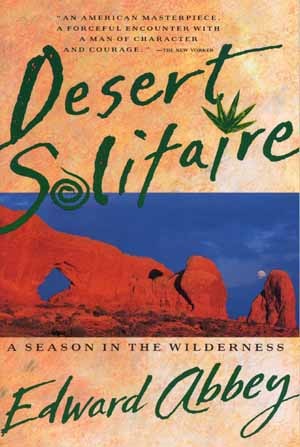
Desert Solitaire
It’s been a good twenty years since I read this, and it’s long overdue for a re-read. Edward Abbey’s Desert Solitaire: A Season in the Wilderness sparked my now decades-long love affair with hiking and natural places, although this isn’t a book about hiking per se. Desert Solitaire chronicles Abbey’s three seasons as a park ranger in the Four Corners region of the American Southwest. Abbey, in all his curmudgeonly glory, managed to turn me into a die-hard tree hugger in my impressionable twenties, and while my environmental sensibilities aren’t quite as fervid or radical as they once were, I still give thanks to Edward Abbey each time I head down the trail.
No way in hell my entire Baker’s Dozen (Plus One) list will fit into one blog entry, so I hope that I can entice you back for Part II in a few days. Peter Matthiessen, Ayn Rand and Lee Smith are waiting in the wings!
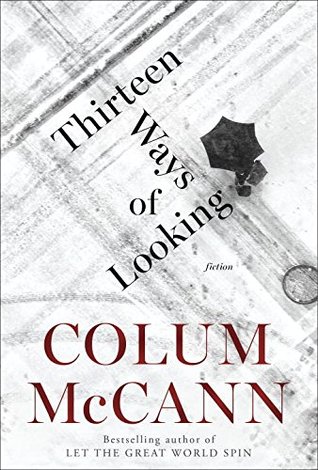
More short stories. The last two books I finished were short story collections and I wasn’t sure I wanted to move on to another. “Shit,” I said, “it’s Colum McCann. You know you’re going to love it.” And I did.
In “Thirteen Ways of Looking”, the title novella, an elderly, retired judge reflects back on his life during the course of what, unbeknownst to him, will be his last day on this earth. He’s insightful, he’s funny in that funny, old-man kinda way, and he is one rich character! I felt like he was going to totter right off the page with his walking stick and right into my den. I found myself wishing he actually had but that would have really freaked my dogs out! Security cameras record each moment of that final day: Hidden cameras in his home (installed by a son intent on catching the live-in help in something illicit) capture his morning rituals, cameras located in the common areas of his apartment building and on the street paint a picture of his daily, noon-time foray, and the video system at Chialli’s (his usual lunch spot) pieces together his final minutes and seconds. As Judge Mendelssohn takes stock, it feels as if we also have a video link directly into his brain: We’re party to every thought, every memory, every tangent his mind takes, right up until the moment of his demise.
While Judge Mendelssohn is one immensely likeable old dude, his son Elliot is another matter altogether. In the most heartbreaking vignette of the story, Elliot, self-absorbed, self-important asshole that he is, joins Pops for lunch but then spends nearly every minute on his cell phone.
A writer is commissioned to write a New Year’s Eve-themed short story in “What Time Is It Now, Where You Are?” and McCann takes us both into the story the author writes and into the author’s mind as he writes it. It’s absorbing insight into the way a writer thinks, how he inhabits his characters, asks the questions they would ask.
“Sh’khol” is every parent’s nightmare. What happens when you turn your back for that one second (or hour . . . or hours in this instance), when you allow yourself to lapse into inattention for just a little too long? And when the child has special needs, the agony is compounded.
In “Treaty”, a septuagenarian nun realizes that the man who once held her brutally captive has become a proponent of peace.
McCann is a hell of a writer, a true literary heavyweight. He’s one you read for the sheer joy of the way he works the language. It seems effortless from our perspective, but if fiction writing is at all autobiographical, then I think McCann is telling us in “What Time Is It Now, Where You Are?” that writing is anything but easy. Still he makes it look that way. He has a true gift for expressing the inner workings in each of his characters minds: the searching, the questioning, the whys and wherefores, the answers we’re constantly looking for and only sometimes finding, the sheer humanness of just being human. He makes me jealous that I don’t have that gift, dammit!
As an example of the utter realness of McCann’s writing, I keep going back to a passage from “Thirteen Ways of Looking”, as Judge Mendelssohn assesses his lunch-time waitress: “Genuine it seems: she’s not just blowing smoke, like half the waitstaff seem to do every day, their mundanities, nice to see you, have a good day, are you still working on that, sir? I’m eating, young lady, not working.” McCann absolutely nails the laissez-faire attitude of many young people today in this one musing of Mendelssohn’s, and Mendelssohn’s attitude towards it. I have to say that attitude is a pet peeve of mine too, and I’m not nearly so old as Mendelssohn. It’s like when you tell your server, “Thank you”, and they shoot back, “No problem.” Of course it’s “no problem”. It’s YOUR JOB! Whatever happened to “You’re welcome”? Where is Emily Post when we need her? But I digress.
McCann will probably rack up tons of awards and accolades for this collection and deservedly so. These are stories you keep thinking about and reflecting on long after you’re finished. For the title novella alone, I give this collection 5 stars. This one made me want to sing, y’all!
Have you read it or planning on reading it? Let me know what you think.
A review copy of this book was provided to me by Random House Publishing Group – Random House via NetGalley. I would like to thank the publisher for providing me this opportunity. All opinions expressed are my own.
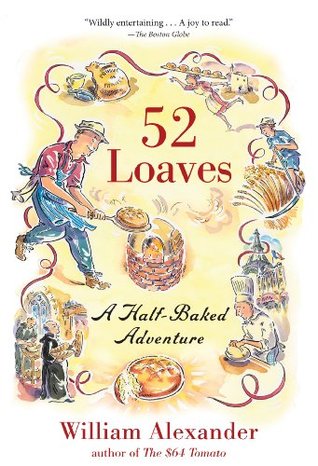
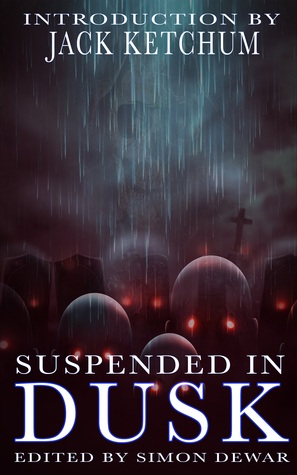
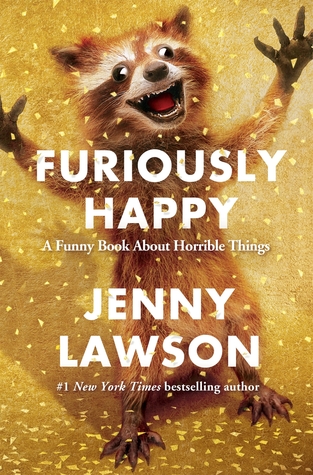
I usually have my nose stuffed in three or so books at any one time: one physical book, one or two Kindle books and one audiobook. Right now, I’m reading the trade PB of 52 Loaves: A Half-Baked Adventure, by William Alexander; Colum McCann’s Thirteen Ways of Looking (which just dropped today from Random House) on Kindle, as well as a horror, short-story anthology, Suspended In Dusk, edited by Simon Dewar (also on Kindle); and finally, on audio, the second installment in Marcus Sakey’s near-future Brilliance Saga, A Better World, narrated by Luke Daniels (love me some Luke D.!). I’ve just finished Furiously Happy: A Funny Book About Horrible Things by Jenny Lawson (aka The Bloggess) but wish it had been about a thousand pages longer. It deserves, and will get, a blog post all its own.
The audiobooks carry me through my one-hour long commute each day (one-way!) and the Kindle editions keep me going through endless miles on the treadmill. The actual books and the Kindle versions compete for the remainder of my reading hours . . . or minutes or seconds! All depends on when I can squeeze in a few more word-filled moments throughout my day.
If I had a nickel for every time someone has whined to me, in the most high-pitched, nasal tone she can muster, “I love to read but I can never find the time” . . . Believe me, if you truly want to read you will make the time. Besides the drive time and the gym, I also squeeze in a few pages while I get ready for work in the morning, on my lunch break, while the Hubs watches something loud and obnoxious on television (i.e., war movies, more war movies, and oh, did I mention war movies?), and lying in bed at night waiting to fall asleep. It’s not that difficult if you put your mind to it . . . unless you have kids – then I know the challenge is truly amplified for you and your priorities are where they should be, with your kids. Sure, I would much rather have a solid, uninterrupted hour or two (or three or four or five!) to really dig in and lose myself in whatever I’m reading but that’s not always realistic. I’ve learned to appreciate the time I can get, when I can get it and to make the most of it!
So, first blog post EVER! Why am I doing this? I read and I love to talk about what I read. So join a book club, you say, if you want to discuss your reading choices.
Tried that. Didn’t like it so much. The reasons why would fill up an entire blog post on their own so I won’t bore you with that here. Maybe later . . . in another life.
My mother is the only person I know who reads as much as I do and who just as thoroughly enjoys talking about what she reads. We have our own little book club of two and we hash out what we’re reading on the phone everyday as I make my tedious one-hour commute home from work. We’re not always reading the same books at the same time, but we talk about them nonetheless. She gives me her reading suggestions and I return the favor.
So why don’t you write a little memoir about that, you say? Well, I think Will Schwalbe already did something similar with The End of Your Life Book Club. Only difference is my mom’s not dying, at least not yet!
But Mom won’t be here forever and I can barely get my husband to crack open a book, so I decided to do this for myself mostly. I can talk here ad nauseum about the books I love and the books I didn’t love. If no one ever reads this little blog, so be it. That’s fine by me. But if I manage to turn one person on to a book, author or genre they might not otherwise have discovered or tried, then I’ve done my good deed for the day.
I may also have a slight case of bibliomania. I have way more books than I’ll ever be able to read in the near (or even far) future, yet I keep buying more. I get grouchy if I don’t get to read at least 30 minutes or so a day. I honestly don’t care if I never turn on a TV again (except for football – Go Carolina Panthers!).
I’m no literary expert, but I know what I like and what I don’t like, what works for me and what doesn’t. This isn’t rocket science or quantum physics. It’s just me talking about the books that make me want to sing, the ones that I get a good laugh over and the ones that I want to flush down the toilet. I welcome your comments. Your opinions may differ. That’s okay. No one ever said we have to like the same things. But I do believe we have to respect the opinions and ideas of others and agree to disagree sometimes.
Don’t expect to read about new releases all the time, although I will spotlight those as I do receive ARCs from various publishers. I delve deep into the past with my reading choices too. In fact, I spend most of my time futilely trying to catch up on my “to be read” stack, so unless I’ve received something new directly from the publisher for review purposes, you’ll find yourself reading my musings on the dusty piles cluttering every corner of my house more often than not. No matter. A good book recommendation is a good book recommendation regardless of the copyright date of the thing.
And I reserve the right to blather on about any other subject that comes to mind if I choose. It is my blog after all. Some days I may want to gush over the wonderful creatures that are the two American Saddlebred horses that I ride and show, or I may want to talk about my dogs, or God forbid, politics! I also cuss like a sailor and I apologize in advance if my salty language creeps in from time to time. I’ll try to keep it clean, but I’m just giving you fair warning now. If you are offended in anyway, do the sensible thing, the thing that reasonable people do, and just exit out of my blog and move on to something more to your liking. Don’t fill up the comment section with reasons why my blog shouldn’t be allowed to continue to exist. Just move on and hang out with people that suit your sensibilities. As I said above, opinions differ and I believe you should respect those differing opinions, not try to eradicate them from the face of the Earth!
With that said, this blog is officially a reality. Welcome, and I hope your life is filled with good books and good company!




 a day in the (reading) life