Savage Appetites: Four True Stories of Women, Crime, and Obsession

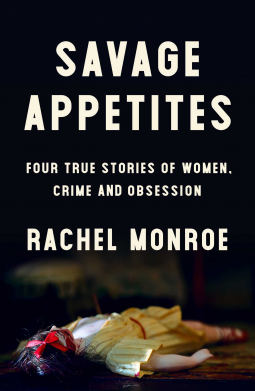
Now just hold your horses, all you obsessed, bloodthirsty, thrill-seeking ladies out there.  This title would have you devouring the pages of the book, ripping at them with fang and claw…..drooling.  ‘Fraid not.  This is sociology, my friends, and, according to the sociological theorizing in Rachel Monroe’s book, it is the ladies who are obsessed with true crime.  Maybe, but it does make interesting reading, and the true stories of four women are cited as examples of cultural archetypes – Detective, Victim, Defender, Killer.

The unlikely Detective is Frances Glessner Lee, a wealthy heiress, who, in the Forties, constructed Nutshells, exquisitely detailed miniatures of crime scenes as training tools for law enforcement….how to see and analyze a crime scene.  Arguably, Ms. Lee’s work could be called the beginning of forensic science, introducing a thread that continues throughout the book.  Many of Ms. Lee’s Nutshells still exist and have been exhibited as art.

The Victim is Patti Tate, younger sister of Sharon Tate.  She inherits her mother’s fight for victim’s rights.  The Defender, Lorri Davis, marries incarcerated Damien Echols of the West Memphis Three and works tirelessly for his eventual freedom, one of many women who befriend and, eventually, love imprisoned men, investing them with a bad boy sexiness or a mysterious uniqueness.  The Killer is a very young Lindsay Souvannarath, and her James, internet buddies/imaginary lovers involved online with admirers of Eric Harris and Dylan Klebold.  Mostly chatter and bravado, but Lindsay and James actually make plans to shoot up a mall in Halifax, Nova Scotia where he lived.  Unrealistic plans.  Neither had ever fired a gun, and she insisted on wearing heels.

These four women are springboards for broader discussions, a sociological mash-up that tries to cover the waterfront and is only more or less successful.  A Sisyphean task, either in search of a point or adrift in a sea of them, so don’t obsess over it.  Just leave your savage appetites in the basement and nibble thoughtfully on this one.  Here’s the thing.  Without reference, I named Sharon Tate, Damien Echols, the West Memphis Three, Eric Harris and Dylan Klebold , and you know who they are.  Don’t you?

Savage Appetites takes aim at bookstores on August 20, or thereabouts.  Pre-order here from your local indie bookstore.

Full Disclosure:  A review copy of this book was provided to me by Scribner via NetGalley in exchange for an honest review.  I would like to thank the publisher, the author and NetGalley for providing me this opportunity.  All opinions expressed herein are my own.

Tupelo Hassman’s gods with a little g

I was loving it.  I did love it.  I do love it, but there’s a but, and we’ll get to that later.  Snarkily self-protective high school student Helen Dedleder (hmm, her dad’s a postman) lives in Rosary, California.  Her mother is deceased, so it’s just Helen and her dad, but her dad is zombified with grief, so her Aunt Bev, a psychic, moves to Rosary and opens the Psychic Encounter Shoppe, henceforth referred to as the shoppe.  Now, Rosary, you see, is home to a giant belching refinery, lots and lots of churches and lots and lots of religious folks that Helen calls Thumpers.  The Thumpers pretty much control Rosary, and they are not happy to have a psychic shoppe in their town.  They’re even more unhappy with Aunt Bev’s second job in the back of the shoppe after hours.

Helen and her friends call themselves the Dickheads and they hang out after school at Fast Eddie’s Tire Salvage, drinking beer.  Thumpers aren’t happy with the Dickheads either, and the Dickheads aren’t happy with the Thumpers, so there you go.  Me, I was riding the crest – sexually-obsessed teenagers, quirky misfit angst, a rollicking good time.  Then, near the end, almost home-free with a standing ovation, Ms. Hassman throws in an ill-advised scene that gave me the vapors.  I won’t go into it, but I will say that no one is hurt, so there’s that.  It is, however, ugly, unnecessary, and unnecessarily ugly.  Now this particular scene might not bother you; it doesn’t have to.  And, when all is said and done, this is a meaningful book, a raucous riot of a book, but……..it did bother me.  So, other than that, Mrs. Lincoln, how did you like the play?

Farrar, Straus and Giroux will put this novel in your hands on August 13 as long as you shop your local indie bookstore.

Full Disclosure:  A review copy of this book was provided to me by Farrar, Straus and Giroux via NetGalley in exchange for an honest review.  I would like to thank the publisher, the author and NetGalley for providing me this opportunity.  All opinions expressed herein are my own.
Superlative: The Biology of Extremes

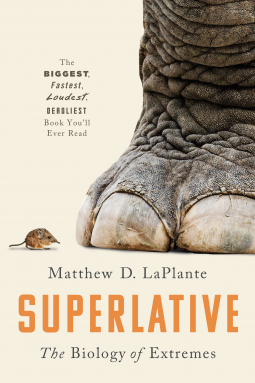
The outliers:  biggest, smallest, deadliest, smartest, strongest, oldest, fastest.  A sort of Guinness Book of Records for grown-up nerds, huh?  Same fascination factor, for sure, but with purpose and science to boot.  What can we learn from these extremes of nature?  How did they come to be?  What are the challenges to their survival?  How can they benefit us?

For example, in “Why Almost Everything We Know About Giraffes Is Wrong”, we learn that prevailing theories say giraffes developed their unique bodies and long necks in order to graze from tree tops.  But did they?  They seem to bend down to eat from grasses and shrubs as much, if not more, than in trees.  So why those long necks with those pretty little heads at the top?

And there’s “Why Elephant Cells Are Like Empathetic Zombies”.  Elephants grow so rapidly that cells tend to mutate, and so it seems that elephants would develop cancers at an astounding rate – but they don’t.  In elephants, mutating cells appear to “develop a conscience” and die.  Now wouldn’t it be great if our pre-cancerous cells offed themselves?  Yeah, that’s the ticket, and we’d have elephants to thank, so back off, poachers!

I’ve only sampled Matthew LaPlante’s good book, but I’ll be back, and it’s perfect for enjoying this way if you like.  Of course, for many, it’ll be like potato chips.  Hard to stop with one or two.  Whatever your style, munchies or the full buffet, the line starts here.

Be the biggest, smartest, fastest reader to buy this book from your local indie bookstore.

Full Disclosure:  A review copy of this book was provided to me by BenBella Books via NetGalley in exchange for an honest review.  I would like to thank the publisher, the author and NetGalley for providing me this opportunity.  All opinions expressed herein are my own.

Billy O’Callaghan’s My Coney Island Baby

On a bitterly cold, windy winter day, Michael and Caitlin meet at Coney Island.  It is deserted, shuttered, “…a place for the damned to drift, wait their turn at nothingness.”  They’ve been meeting here for twenty or so years, spending one afternoon a month (first Tuesdays) in a series of worn motel rooms, and this one particular winter afternoon frames the entirety of Billy O’Callaghan’s poignant novel.  This afternoon is no different from all those that came before, but they are growing older, and for all those years, at the end of all those first Tuesdays, Michael returns to Barb and Caitlin returns to Thomas.  Lives are lived, time passes.  We are bound, and the status quo is durable.  But what about endings?  Will there be a hiding place from endings?  Will we even recognize them when they come?

Mr. O’Callaghan is an Irishman with a prodigious gift, the gift of words, words that rasp, tumble, lilt, thunder and ravish.  At times, perhaps, a bit self-indulgent, but if you love the magic of words, this is pure pleasure all the same.  In spite of this bounty, I was not totally invested in Michael and Caitlin as a couple, in their relationship, the doggedness of it.  It just seems so unlikely.  Is “why” the central question, the one we’re meant to ask?  If so, then I’m asking it, but the answer is beyond me.

There are three books of short stories and one other novel, The Dead House, by this talented author, and, based on the richness he brings to the backstories of Michael and Caitlin in Coney Island Baby, I’m thinking short fiction may be his forte, but no matter.  He can write the lights out.

Out now so support your local independent bookseller by ordering here.

Full Disclosure:  A review copy of this book was provided to me by HarperCollins Publishers / Harper via NetGalley in exchange for an honest review.  I would like to thank the publisher, the author and NetGalley for providing me this opportunity.  All opinions expressed herein are my own.
Soren Sveistrup’s The Chestnut Man

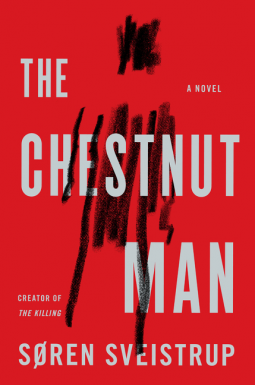
Am I right in thinking that, ever since The Girl with The Dragon Tattoo made such a splash, Scandinavia has become the epicenter of smartly written mystery thrillers?  Maybe it’s the long, cold winters, huh?  Nothing to do but cozy up by the fire, drink hot chocolate, and dream up unspeakable acts of utter depravity.  Then it’s either write them up or commit them, I guess, but scriptwriter and TV producer Soren Sveistrup writes, thank goodness, and he does it well.  His creation, the Chestnut Man himself, is a shoo-in candidate for the Boogey Man Hall of Fame – whip smart, cool as a cucumber, driven by vengeance, and he is human.  Well, he looks human, anyway.  And speaking of deceiving appearances, seedy, sad sack detective Mark Hess, on reassignment for Europol, is sharper than he appears and finally puts it all together after local authorities have botched it.  You know they did.  Mark’s character will pique your interest, and so I’m thinking, hoping, more to come, maybe.  In the meantime, read this one, and if someday you stumble upon a crude doll, a little man made of chestnuts and matchsticks, run……..run like the Boogey Man is after you.

This one won’t be released for a couple of months, September 3 I believe, but it’s worth the wait.  Support your local indie bookstores and pre-order here.

Full Disclosure:  A review copy of this book was provided to me by HarperCollins Publishers / Harper via NetGalley in exchange for an honest review.  I would like to thank the publisher, the author and NetGalley for providing me this opportunity.  All opinions expressed herein are my own.

Silver, Sword, and Stone: Three Crucibles in the Latin American Story

After finishing Silver, Sword, and Stone:  Three Crucibles of the Latin American Story, I felt as if I’d been beaten about the head and ears.  The “brutal calculus” of Latin American history simply clobbered me, left me reeling.  Marie Arana calls her book a mixture of history and reportage, and that approach, I think, is what makes it so readable, but her work is massive in both scholarship and scope:  from the Pre-Columbian to the Perons, conquistadores to Castro, Santiago to Pope Francis I.  Its structure and focus are derived from three major currents, co-equal driving forces of Latin American history, identified in the title as silver, sword and stone.

Silver for wealth:  mineral, agricultural, fossil fuels, and drugs.  Sword for violence:  war, conquest, revolution, terrorism, dictatorships, gangs.  Stone for religion:  the Sun God, ancient sacrifices, Catholicism, missionary zeal, political involvement.  All leading to or resulting in weakened extractive societies and exploitation driven by greed.  For each of the three, Ms. Arana weaves in a humanizing touch, stories of three individuals, living examples of silver, sword and stone in today’s Latin America.  Leonor Gonzales is the wife, now widow, of a sick, impoverished gold miner.  Carlos Buergos, a petty Cuban criminal, fought in Angola and was expelled from Cuba when Castro emptied the prisons of “undesirables”.  Spaniard Xavier Albo, a Jesuit priest from Catalan, has served the Church in Bolivia since he was seventeen and is now in his nineties.

To this day there is a cruelly high economic imbalance between rich and poor in most of Latin America and a pronounced arc toward violence and instability.  Latin American countries and cities are often in the majority on lists of the World’s most dangerous. Exploitation and greed, internal and external, historic and current.  Ms. Arana is both fair and thorough in her examination of these volatile parts of our world, and her timely book is a good balance of scholarship and readability.  Effective and affecting.

Available at booksellers everywhere on August 27, 2019. Shop your local indie bookstore to pre-order.

Full Disclosure:  A review copy of this book was provided to me by Simon & Schuster via NetGalley in exchange for an honest review.  I would like to thank the publisher, the author and NetGalley for providing me this opportunity.  All opinions expressed herein are my own.

Greg Keen’s Soho Angel

Title #3 in a series I did not know, the Soho Series, and it is a ton o’ fun.  Of course, if being hung by your heels in an abandoned abattoir and threatened with a bolt gun by a guy wearing a Trump mask is not your idea of fun, well, then….catch you later, OK?  Kenny Gabriel is a down-at-heels PI, the sole employee of OC Trace and Find where he does the leg work for the owner, a morbidly obese agoraphobic named Odeerie, and he drinks himself to sleep every night on Monarch of the Glen.  You see, all kinds of “nice” touches.  There are weird aging rock stars, an ex-roadie, now tattoo artist, named Sweat Dog, and the body?  Oh, it’s been right where they left it for over twenty years.  Unfortunately we will have to wait for #4 to find out if Kenny survives his surgery…….hey, no fair!  In the meantime, track down numbers 1 and 2, Soho Dead and Soho Ghosts.  Promising leads.

Shop your local indie bookstore for all the titles in the Soho series.

Full Disclosure:  A review copy of this book was provided to me by Amazon Publishing UK / Thomas & Mercer via NetGalley in exchange for an honest review.  I would like to thank the publisher, the author and NetGalley for providing me this opportunity.  All opinions expressed herein are my own.

Binnie Kirshenbaum’s Rabbits for Food

This is quite a Bunny you’ve pulled out of your writer’s hat, Ms. Kirshenbaum.  Who is this Bunny?  I don’t want to pry, but maybe bits of you, maybe bits of someone you know, maybe bits of all of us?  She’s too unique, I think, to be everyone who’s ever been deeply, seriously depressed.  Bunny is a writer, married to sweet, conciliatory Albie; she’s a middle child, brutally honest, a “more or less” friend of some pretentiously intelligent folks, and she does not like party hats.  Oh, and she’s also deeply, seriously depressed.  Deep enough to affect Bunny’s hygiene.  Serious enough to cause self-harm in a weird and public way.

Rabbits for Food?  Bunny and this book of Bunny will devour you, and it will spit you out undigested and wondering, maybe for the rest of your life.  From an opening line you cannot walk away from to the enigma of the end.  An end that you know is a sure and certain truth, but, even so and in spite of, you can only hope is true…….and you must wonder what if it is not.  Maybe for the rest of your life.  Ms. Kirshenbaum, I salute you.

Available now from booksellers everywhere so hop on out for your copy or click to shop your local indie bookstore.

Full Disclosure:  A review copy of this book was provided to me by Soho Press via Edelweiss in exchange for an honest review.  I would like to thank the publisher, the author and Edelweiss for providing me this opportunity.  All opinions expressed herein are my own.

Grace Will Lead Us Home: The Charleston Church Massacre and the Hard, Inspiring Journey to Forgiveness

That subtitle basically says what needs to be said.  Jennifer Berry Hawes gives us an even-handed look at the horror in Charleston on June 17, 2015.  An atrocity that, for a moment in time and shared grief, appeared to unite us in a complete reversal of Dylann Roof’s avowed hope for race war.  Nine innocent lives are lost at historic Mother Emmanuel, and there is a tenth, lost but not innocent:  the shooter, lost to hatred.  Ms. Hawes movingly recounts the anguish of the families involved, and willingly recognizes that, as human beings, we are all flawed.  In the aftermath, there are those who inspire us with forgiveness, others who struggle, family quarrels, and church schisms because, well . . . humans, you know.  The book offers no blinding insights or solutions to our ongoing struggles, but rather, it serves to remind us of the healing power of forgiveness and, for those who believe, the grace of God.  Oh, wait, did I say no insights or solutions?  Could be I was wrong.  A thoughtful read.

Out today, June 4, from St. Martin’s Press.  Shop your local indie bookstore for a copy.

Full Disclosure:  A review copy of this book was provided to me by St. Martin’s Press via NetGalley in exchange for an honest review.  I would like to thank the publisher, the author and NetGalley for providing me this opportunity.  All opinions expressed herein are my own.

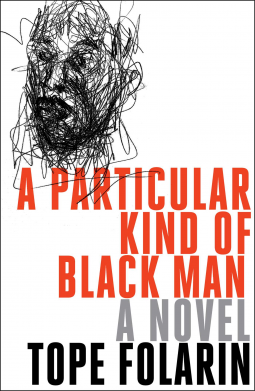
Tope Folarin’s A Particular Kind of Black Man

No one fits precisely into a cubby marked this, that or the other.  No one.  So why do we, much like hermit crabs, try to squeeze into one shell after another to see which one fits, to find the one in which we feel at home?  We all do it, but for young Tunde Akinola there are so many shells, so many identities to try and nothing feels like home.  In this coming of age novel, Tunde grows to be a “particular kind of black man”, a first generation African-American, born in the U.S. to Nigerian parents.  But what is that?

Tunde begins school in Utah where he looks around and sees…..no one like himself.  Utah is mostly white and Mormon.  What, then, is he?  His mother develops mental illness and returns to Nigeria, leaving Tunde and his brother with their father, hard-working, deeply religious and now a single parent.  Enter a Nigerian-born step-mother and her two Nigerian-born sons, a family blended in name only.  His Nigerian grandmother, a voice on the phone, is a constant and steadying influence, but he never meets her face to face.

Small town Utah, next small town Texas, then Dallas, college in Atlanta and Maine, on to D.C.  Son, brother, Nigerian, black, white, juju, pop, Western, Southern, small towns, rural, hip-hop, urban, New England, American, male.  How does a wide-eyed child born into this kaleidoscope find his way, navigate, come to grips…….when, more often than not, exploration is squelched, and welcome is never guaranteed?  And how does one such child grow with assurance into the kind of man he is to become?  What will the essence of this man be?  Tope Folarin’s book is not a “how to”.  It is simply the story of Tunde growing up, but it is revelatory, and, I believe, will leave you changed.  A recommended read.

In bookstores everywhere on August 6 from Simon & Schuster.  Shop your local indie bookstore here.

Full Disclosure:  A review copy of this book was provided to me by Simon & Schuster via NetGalley in exchange for an honest review.  I would like to thank the publisher, the author and NetGalley for providing me this opportunity.  All opinions expressed herein are my own.